

do led lights draw less amps
LEDs are advisable for many lighting applications, they are designed to produce a lot of light from a small form gene while maintaining fantastic efficiency. Hither at LEDSupply, in that location are a variety of LEDs for all kinds of different lighting applications, the trick is knowing how to utilise them. LED technology is a tad different than other lighting that near people are familiar with. This mail is hither to explain everything you need to know about LED lighting: how to ability LEDs safely and then you become the near light and the longest lifetime possible.
What Exactly is an LED?
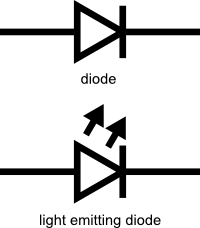
An LED is a type of diode that turns electrical free energy into light. For those that don't know, a diode is an electrical component that simply works in 1 direction. Basically, an LED is an electrical component that emits calorie-free when electricity flows through in i direction, from the Anode (positive side) to the Cathode (negative side). LED is an acronym standing for 'Light Due eastmitting Diode'. Basically, LEDs are like tiny calorie-free bulbs, they just require a lot less power to light upward and are much more efficient in producing high light outputs.
LED Types
In general terms, we carry two different types of LEDs:
5mm Through-Hole & Surface Mount.
5mm LEDs
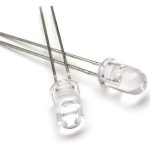
5mm LEDs are diodes inside a 5mm diameter lens with two thin metal legs on the lesser. They are used in applications where a lower amount of low-cal is required. 5mm LEDs also run at much lower drive currents, maxing out at around 30mA, whereas Surface Mountain LEDs require a minimum of 350mA. All our 5mm LEDs are from summit manufacturers and are available in a diversity of colors, intensities, and illumination patterns. Through-hole LEDs are smashing for modest flashlight applications, signage, and anything where you are using a breadboard as they can be used easily with their leads. Bank check out our guide to setting upwardly 5mm LEDs for more info on these tiny light sources.
Surface Mount LEDs (SMD)
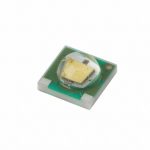
Surface Mount LEDs are diode(southward) that can be placed on a substrate (circuit board) with a silicon dome over the diode to protect information technology (see Fig. 1). We bear high-power Surface Mount LEDs from manufacture leaders Cree and Luxeon. Both are splendid in our opinion, that is why nosotros carry them later on all. Some prefer one over the other but that comes with experience and knowing what to look for. Cree tends to have higher listed Lumen outputs and is a market leader in the High-Power LED sector. Luxeon, on the other paw, has excellent colors and thermal control.
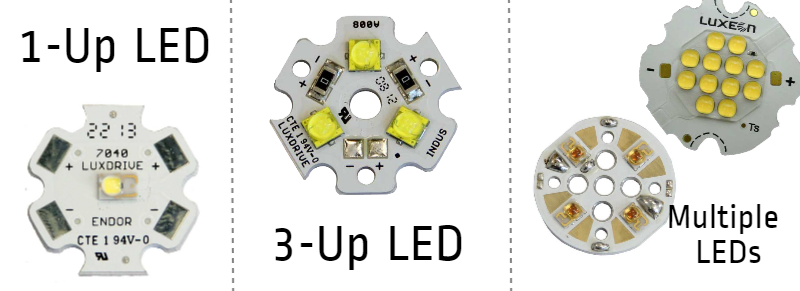
High Power LEDs come as blank emitters (as seen in Fig. 1) or are mounted to a Metal Core Printed Circuit Board (MCPCB). The boards are insulated and contain conductive tracks for piece of cake excursion connections. Our 20mm 1-Up and three-Upwardly starboard designs are the best sellers. We too offer QuadPod's which can agree iv high-power LEDs on a lath slightly larger than the 20mm stars (see Fig. 2). All our high-power LED options can exist congenital on a linear pattern besides. The LuxStrip tin can firm 6 LEDs per foot and is easily connected upwardly to ten feet long.
Polarity Matters: Wiring LEDs
Electronic polarity indicates whether a circuit is symmetric or not. LEDs are diodes, therefore only allowing current to flow in one management. When there is no electric current catamenia, there will be no calorie-free. Thankfully this means that if we wire an LED in astern, it volition non burn the whole organisation up, information technology merely won't come on.
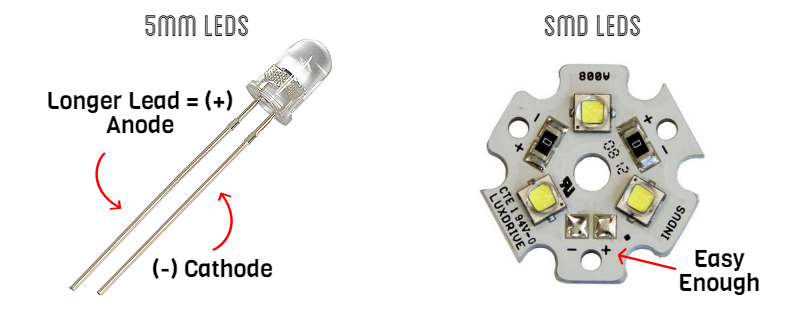
The positive side of the LED is the Anode and the negative side is the Cathode. Electric current flows from the anode to the cathode and never in the other management, and so information technology is of import to know how to tell the anode and cathode apart. For surface mount LEDs this is like shooting fish in a barrel as the connections are labeled, but for 5mm LEDs ook for the longer lead which is the anode (positive), have a look at Figure 3 below.
Color Options
One of the slap-up things about LEDs is the unlike options and kinds of light you can go from them.
White LEDs
Correlated Colour Temperature (CCT) is the process of creating dissimilar white low-cal at dissimilar temperatures. Colour temperature is specified in degrees Kelvin (K), which is a temperature calibration in which zip occurs at accented zero and each degree equals one Kelvin. The lower temperatures from 3,000K to 4,500K tend to exist warmer to neutral white. The higher temps 5,000K+ are the cool whites, too known equally 'daylight white'.
Color LEDs
For colors, what really matters is the wavelength in nanometers (nm). For certain applications, colors are needed for the visual issue, merely sometimes certain wavelengths are needed for applications like curing, growing, reef tank lighting, and much more than. See Fig. 4 for an idea of what wavelengths and temperatures produce sure colors.
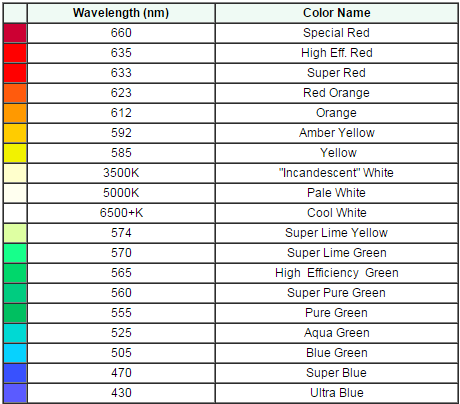
We effort to carry like colour temperatures and wavelengths for each brand and blazon of LED. You tin can always find the color or wavelength of our LEDs on the sub-section of the product page and can even search by color from our LEDs dropdown menu on the homepage. In white, we comport 3000K, 4000K, 5000K, and 6500K. Equally far every bit colors go, we comport from 400-660nm.
LED Effulgence
LEDs are not only known for their colors, they are as well a lot brighter than other light sources. Sometimes it is hard to tell how bright an LED volition be because it is measured in Lumens. A Lumen is a scientific unit measuring luminous flux or the total corporeality of visible light from a source. Note that 5mm LEDs are usually listed in millicandelas (mcd). For 5mm LEDs, their viewing angle likewise affects the light output they give off, for more than on that see here.
Why drive electric current matters…
The corporeality of low-cal (Lumens) an LED emits depends on how much electric current is supplied. Current is measured in milliamps (mA) or amps (A). High-power LEDs tin take currents from 350mA to 3000mA. LEDs vary on their current ratings and then be sure to keep track of this when picking an LED and driver.
Determining the Brightness
Now comes the tricky part, selecting the LED and driver combination that will output the light needed. We accept done a lot of the groundwork here, in a post measuring the effulgence of each high-power LED at different drive currents. Accept note that these are measures for 1-Up stars then if you lot want more light the 3-Upward LEDs are a good pick as they are triple the light within the aforementioned footprint.
The above resource tin always be used for determining the light output from an LED, merely finding information technology manually is not very hard.
To practice so, information is needed from the datasheet of the LED. On all of our LED pages, we link to the manufacturer's datasheet at the lesser of the page.
Example: Finding brightness of Cree XP-Fifty at 2100mA
In this example, we are using the Cree XP-L. First, find the Flux Characteristics table (figure 5). We volition impact binning later which is labeled in the 'Group' column, but permit us presume we are going to employ a absurd white XP-L from the highest bin (v5). The highlighted number is the typical flux @ 1050mA which is the electric current the XP-L is measured at. To the right of that are the typical Lumen numbers for 1500, 2000, and 3000mA drive currents.
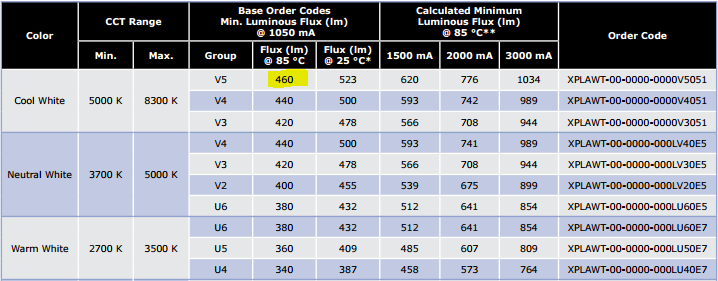
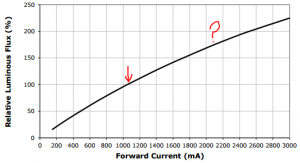
For the sake of this case, say we want to run this LED with a 2100mA BuckBlock LED driver and we need to discover what the light output would be similar. When driving an in-between bulldoze current that is not listed, find the relative flux vs. current graph on the datasheet that looks like the graph to the right.
The arrow is the tested (base) output (at 100% relative flux). Following the curve to 2100mA (?) we run into that this is a 75% increase in light. Taking the 460 lumens from to a higher place and multiplying it past 1.75 we can see that the absurd white XP-L running at 2100mA gives off most 805 Lumens.
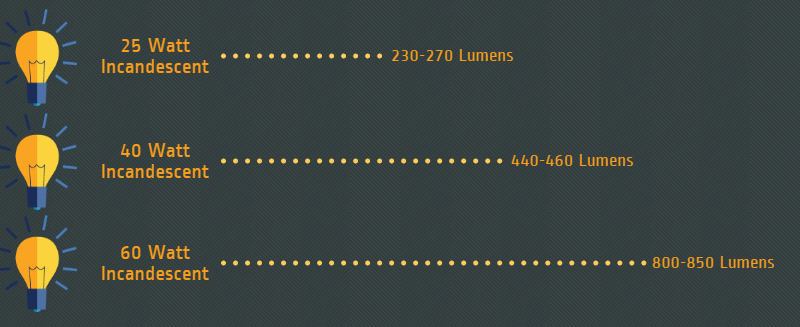
It may exist hard to detect the LED and Lumen output needed when switching to LEDs. This is due to the fact that light was e'er measured past the wattage of a bulb. LEDs accept much improve efficacy which makes it about impossible to measure in this mode anymore as a 50 Watt LED will be significantly brighter than a 50 Watt Incandescent. In Figure vii we testify different incandescent bulbs and how many Lumens they give output. This helps give a amend idea of the calorie-free to wait from an LED and if it volition be equally much as the sometime lighting.
Viewing Angle and Optics
Our 5mm LEDs have listed viewing angles for each and then just search for one that volition piece of work for you. As far every bit our surface mountain LEDs go, near of them give off a very wide angle at 125 degrees! Luckily, the LED starboards are compatible and like shooting fish in a barrel to employ with LED eyes. These secondary optics are used to focus the lite, they can reflect the light from an LED into spot, medium spot, wide spot, or elliptical and oval patterns.
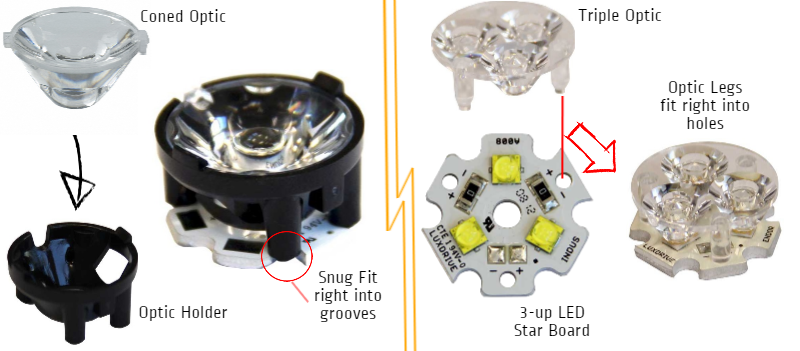
As seen in Figure viii, 1-Up optics are cone-shaped and require an optic holder. In the case of our LED boards, optic holders take iv legs that sit down into the grooves of the star. Triple LED stars are too uniform with Carclo eyes, built with three holes in the lath for the legs of the optic to fit in.
How to Power LEDs
LEDs are known for having the best efficacy out of all other light sources. Efficacy is the measure of how well a light source produces visible light, also described equally Lumens per Watt. In other words, how much low-cal are we getting for our watt of ability? To find this, first, discover out the wattage of the LED in use. In society to find watts, y'all need to multiply Forward Voltage (the voltage at which electric current starts to catamenia in the normal conducting direction) by bulldoze current in Amps (notation that it NEEDS to exist in amps…not milliamps). Permit's take a wait at the Cree XP-L 1-up LED every bit an instance.

Say we are running this Cree XP-50 at 2000mA. From Figure 8 you can come across that at this drive current the forward voltage is 3.15. So to notice watts we multiply 3.15 (forward voltage) past 2 A (2000mA = 2 Amps) which comes out to be half dozen.3 Watts.
So at present to detect Efficacy, we simply demand to split 742 Lumens (the tested amount of Lumens for this LED at 2000mA) by half-dozen.three Watts. So the Efficacy (Lumens/watt) of this Cree XP-L is 117.8. This is peachy efficacy merely besides note Cree boasts that the XLamp XP-L LED has quantum efficacy of 200 lumens/watt running at 350mA. It is proficient to know that the efficacy goes down every bit you run more current to the LED as this increases estrus which does make the LED a fleck less efficient. Sometimes you lot volition need to accept this if yous need the LED to be very bright, but if you are wanting to go the best efficacy then yous should run LEDs at a lower current. This is all helpful in determining how much power your applications will demand too as figuring out energy savings downwardly the road.
A little bit more on LED drivers
This means that you need to notice an LED driver that has the capability of driving LEDs at the current you need in order to get the amount of Lumens you'd similar. An LED Commuter is an electrical device that regulates the power to an LED or string(southward) of LEDs. The commuter responds to the irresolute needs of the LED by supplying a constant corporeality of power to the LED every bit its electrical properties alter with the temperature. A good analogy in agreement this is that of a motorcar on prowl control. Equally the car (LED) goes through hills and valleys (temperature changes), the prowl control (commuter) makes sure information technology stays at a steady speed (light), regulating the gas (ability) needed in doing and so. The driver is and then important because LEDs crave very specific electrical power in gild to operate properly. If the voltage supplied to the LED is lower than required, very little current runs through the junction, resulting in depression low-cal and poor performance. On the other hand, if the voltage is also great, likewise much current flows to the LED and it can overheat and be severely damaged or fail completely (thermal runaway). Always make sure yous bank check the LEDs datasheet so you know what electric current is recommended to avert these issues.
How much voltage practise I demand to calorie-free up an LED?
This is a mutual question asked and is really pretty piece of cake to figure out. All you lot demand to know is your LED(south) frontwards voltage. If you have multiple LEDs in series then you lot need to have into account all the forrad voltages combined, if you take a parallel circuit then you only demand to take into account the forward voltage of how many LEDs you lot have per cord. For more on wiring setups, encounter here. It is a good thought to keep at least a 2 volt overhead as some drivers (similar the LuxDrive drivers) require this for the driver to work properly. So if your total forward voltage for a series excursion is nine.55, you should be safe with a 12V supply. For off-line drivers (AC input) merely know the output voltage they are rated at and make sure you are covered, and then an AC input commuter with an output range of 3-12VDC would work for this application too.
Estrus Control
Finding the wattage of your system also helps y'all know more nearly the heat command you lot will need. Since these LEDs are loftier-power, they exercise create rut which can be very bad as you tin can learn here. Too much heat volition make the LEDs produce less light too every bit cut downwards on the lifetime. Nosotros always recommend using a heatsink and like to say to use about three square inches for every watt of LEDs. For larger wattages, I would recommend looking for a heatsink that is recommended for the number of watts you are running.
LED Binning & Quality
With the LED industry growing at a pretty rapid pace correct now, it is important to understand the difference in LEDs out there. This is a common question every bit LEDs can range from very inexpensive to very expensive. I'd exist conscientious in buying cheap LEDs as you e'er go what you lot pay for, aye the LEDs might piece of work great at offset but they commonly tend not to last equally long or will burn down out fast because of poor testing.
All the LEDs carried here at LEDSupply are advisedly selected. Nosotros simply stock the best brands and color temperatures. Our vast feel in the industry has helped us learn the importance of quality manufacturing and binning of LEDs also. In the manufacturing of LEDs, in that location is a variation of performance around average values in the technical datasheets. For this reason, manufacturers bin the LEDs for luminous flux, color, and forward voltage. We select the bins with the highest luminous flux (visible light) and everyman frontwards voltage, as this makes sure we have the LEDs with the all-time efficacy. A large amount of LED products are cheaply made and not documented correctly, which leads to many failed projects so makes people call back LEDs really don't terminal equally long equally they are said to. With our experience and buying power, we are able to offer the best products at reasonable prices.
This should requite you lot a good start to understanding LEDs and what to expect for, merely if you lot take more questions or would like more than info on a sure product and whether it would piece of work for you, we are here to aid. Just electronic mail u.s. at sales@LEDSupply.com or call us at (802) 728-6031 to conversation with our very knowledgeable Tech Support Team.

Source: https://www.ledsupply.com/blog/what-you-need-to-know-about-leds/
Posted by: rosstooll1958.blogspot.com
0 Response to "do led lights draw less amps"
Post a Comment